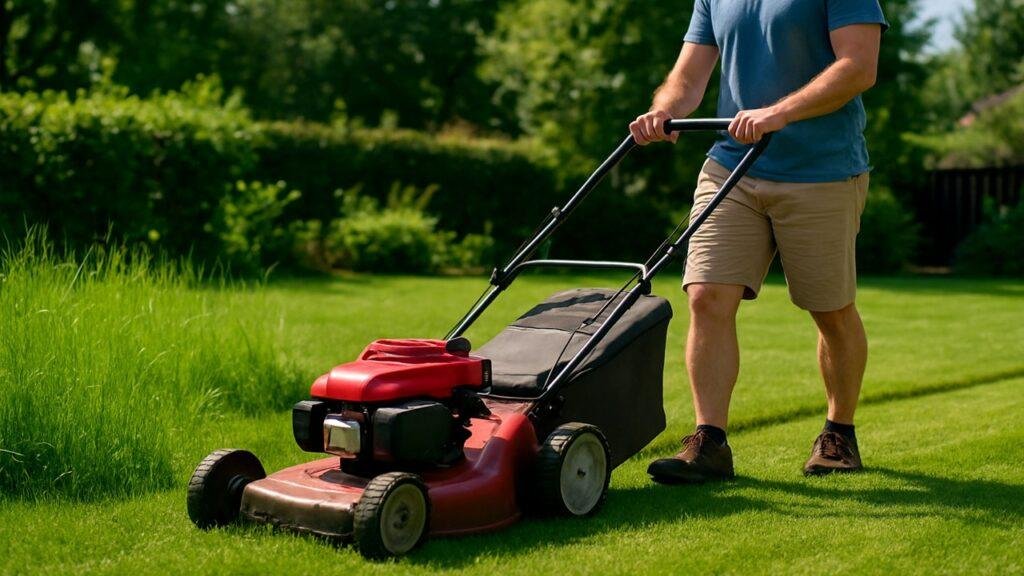
Most people burn between 175 and 600 calories per hour mowing the lawn, depending on their body weight, mower type, and how much effort they put in.
Mowing works as a moderate aerobic activity for most adults and can burn as many calories as a light jog or brisk walk.
Key Summary
- Mowing the lawn burns 175 to 600 calories per hour, with manual and push mowers producing the highest calorie use.
- Body weight, lawn slope, grass thickness, outdoor temperature, and mowing pace all influence total energy burned.
- Manual reel mowers offer the strongest workout effect, while riding mowers provide only light physical activity.
- Mowing counts as moderate aerobic exercise and contributes to your weekly activity goals, especially when done with steady effort.
How Many Calories Does Mowing the Lawn Actually Burn?
Most adults burn 175 to 600 calories per hour while mowing. Manual reel mowers sit at the top of the range because they rely entirely on your pushing force.
Power push mowers fall in the middle because the engine assists the blades but not the movement.
Riding mowers burn the least because most of the work comes from steering rather than physical effort.
A typical person burns 350 to 450 calories per hour with a power push mower, 400 to 600 calories per hour with a manual reel mower, and 175 to 225 calories per hour on a riding mower.
The differences come from how much your arms, legs, and core have to work, your body weight, and the intensity needed to move the machine across the lawn.
Does Mowing the Lawn Count as Exercise?
Yes, mowing the lawn counts as moderate aerobic exercise for most adults. It raises your heart rate, engages your legs, arms, and core, and uses steady walking movement similar to brisk outdoor exercise.
Health organizations such as the U.S. Department of Health and Human Services and Harvard Health classify mowing as a form of physical activity that contributes to your weekly exercise goals.
Pushing a mower requires continuous muscle engagement, which helps improve endurance and functional strength. Even riding mowers offer light physical activity because you are still steering, balancing, and moving through outdoor heat.
Mowing also provides mental health benefits through fresh air, sunlight exposure, and time outdoors, which have been linked to reduced stress.
If you prefer practical, everyday movement over formal workouts, mowing can feel more natural yet still deliver meaningful calorie burn and aerobic conditioning.
This makes it a helpful option for people who want fitness benefits without a traditional gym routine.
Calories Burned Mowing the Lawn by Mower Type
Different mower types lead to different calorie burn levels because each one requires a different amount of physical effort. Manual mowers demand the most energy, power push mowers fall in the middle, and riding mowers require very little full-body movement.
Quick Breakdown
- Manual reel mower: highest effort and highest calorie burn
- Power push mower: moderate effort and moderate calorie burn
- Riding mower: lowest effort and lowest calorie burn
These differences come from the physical workload needed to move the mower, the muscle groups involved, and how much the engine assists you.
Comparison Table: Calories Burned per Hour
| Mower Type | Average Calories Burned | Effort Level |
| Manual reel mower | 400 to 600 | High |
| Power push mower | 350 to 450 | Moderate |
| Riding mower | 175 to 225 | Low |
Manual Reel Mower
A manual reel mower produces the highest calorie burn because it uses no engine power. Every forward motion depends on your legs, arms, and core.
This direct physical effort increases heart rate quickly, especially in thick or tall grass.
The resistance from the blades and wheels makes it similar to a full-body conditioning exercise.
For people who want a workout while doing chores, this mower type offers the greatest physical benefit.
Power Push Mower
A power push mower reduces resistance because the engine handles the blade movement, but you still have to push and guide the machine.
This creates steady moderate-intensity exercise similar to brisk walking. Calorie burn stays high, especially on uneven ground or lawns with inclines.
Many homeowners experience this as a practical, manageable workout that fits easily into their routine.
Riding Mower
Riding mowers burn far fewer calories because most of the task involves steering rather than pushing.
The physical demand stays closer to light activity, although heat, vibration, and balance still contribute some calorie burn.
Riding mowers are ideal for convenience and efficiency, but they provide the lowest fitness benefit compared to manual and push models.
Calories Burned Mowing the Lawn by Body Weight
Body weight influences calorie burn because heavier bodies use more energy to perform the same movement. A person who weighs more will burn more calories per hour with any mower type.
Calories Burned per Hour by Weight and Mower Type
This chart shows how calorie burn rises steadily as weight increases. Even a small difference in body weight can change the total calories burned during a one-hour mowing session.
| Weight (lb) | Riding Mower | Power Push Mower | Manual Reel Mower |
| 120 lb | 150 | 300 | 360 |
| 140 lb | 175 | 350 | 420 |
| 160 lb | 200 | 400 | 480 |
| 180 lb | 225 | 450 | 540 |
| 200 lb | 250 | 500 | 600 |
| 220 lb | 275 | 550 | 660 |
Factors That Influence How Many Calories You Burn
Several real-world conditions affect how many calories you burn while mowing. The more physical effort your body has to produce, the higher the total energy use.
Key Factors
- Your body weight
- Lawn slope or uneven terrain
- Grass height and thickness
- Mower condition and blade sharpness
- Temperature and outdoor heat
- Pace and mowing duration
These factors interact with each other, and even small changes can shift your calorie burn noticeably.
Body Weight
Body weight plays a major role in calorie burn because heavier bodies require more oxygen and muscle activation to perform the same task.
Two people mowing the same lawn for the same time can burn very different amounts of energy simply due to weight differences.
Lawn Slope and Terrain
Slopes increase resistance by forcing your legs and core to stabilize every step. Bumpy, uneven ground also demands more balance and muscle control, which raises your heart rate.
Grass Height and Thickness
Tall or dense grass increases pushing resistance. Your arms, shoulders, and legs work harder, especially with manual or push mowers.
This is why mowing after heavy rain or long growth periods feels more strenuous.
Mower Condition
A mower with dull blades requires more pushing force. A mower that rolls smoothly and cuts cleanly reduces the workload.
Maintenance directly influences physical effort.
Temperature and Weather
Heat raises your heart rate, increases sweat loss, and pushes the body to use more energy for cooling.
Hot, sunny days naturally increase calorie burn but also require more hydration.
Mowing Pace and Duration
Short, brisk passes burn more calories than slow, relaxed mowing. Consistent movement without long idle breaks keeps your energy use high throughout the session.
Calories Burned Calculator for Mowing the Lawn
A calorie calculator helps you estimate energy use based on weight, MET value, and time spent mowing. It gives a more accurate number than generic averages.
What You Need
- Your weight in kilogram
- The MET value for your mower type
- Total mowing time in minutes
This formula provides a personalized estimate for any mower, lawn size, or intensity level.
The MET Formula Explained
Calories burned per minute = (MET × weight in kg × 3.5) ÷ 200
MET values vary by mower type:
- Riding mower: 2.5 MET
- Power push mower: 4.5 to 5.0 MET
- Manual reel mower: 6.0 MET
A heavier person with a higher MET activity will always burn more calories.
Example Calculations
A 180 lb (81.65 kg) person using a push mower at 5.0 MET for 60 minutes:
Calories burned = (5 × 81.65 × 3.5) ÷ 200 × 60
≈ 430 calories
A 150 lb (68 kg) person using a manual mower at 6.0 MET for 45 minutes:
≈ 321 calories
These examples show how mower type and weight significantly affect total energy use.
Mowing the Lawn vs Other Yard Activities
Yard work varies widely in physical demand. Some tasks burn more calories than mowing, while others burn less.
A manual mower session can burn more calories than raking, watering, or leaf blowing but less than shoveling or chopping wood.
Using a push mower is close to brisk walking, while riding mowers sit closer to light household activity.
Mowing also combines walking, pushing, and resistance, giving it a higher average burn than many routine chores.
How Many Calories You Burn Mowing Different Yard Sizes
Yard size changes total mowing time, which directly affects total calories burned. Larger lawns require more passes, more steps, and more physical effort.
Estimated Burn by Yard Size
- Small yard (0.1 acre): around 25 to 35 minutes
- Medium yard (0.25 acre): around 45 to 60 minutes
- Large yard (0.5 acre): around 75 to 90 minutes
- One-acre property: around 120 minutes or more
These are averages based on standard suburban mowing patterns, but your actual time depends on mower type, grass height, and lawn layout.
Small Yard (0.1 Acre)
A small yard usually takes less than half an hour with a push mower. Most people burn between 150 and 250 calories, depending on weight and working pace.
Medium Yard (0.25 Acre)
A medium-sized yard takes up to an hour. Calorie burn generally falls between 250 and 450 calories. Thick grass, slopes, or obstacles can increase effort.
Large Yard (0.5 Acre)
Larger lawns require more walking distance and repeated passes. Many people burn 450 to 700 calories across 75 to 90 minutes of steady mowing.
One-Acre Property
Mowing a full acre can exceed two hours with a push mower. Total calorie burn may approach 800 to over 1,000 calories if the terrain is uneven or the grass is thick.
Steps Taken While Mowing the Lawn
Mowing involves continuous walking, which can add a significant number of steps to your day.
Depending on lawn size and mowing pattern, most people accumulate between 3,000 and 6,000 steps per mowing session.
A larger lawn or slower cutting pattern can push this total even higher.
The combination of walking and pushing creates steady, low-impact movement similar to outdoor cardio exercise.
This makes mowing a surprisingly effective way to increase your daily step count while completing a task you already need to do.
How to Burn More Calories While Mowing the Lawn
You can increase your calorie burn by making small adjustments to how you mow. These changes raise your heart rate, increase muscle activation, and create more continuous movement.
Ways to Burn More Calories
- Use a manual or power push mower instead of a riding mower.
- Mow at a steady, brisk walking pace.
- Cut tall or dense grass in two passes.
- Mow uphill or tackle slopes first.
- Add trimming, edging, or raking after mowing.
- Reduce long pauses or idle breaks.
- Switch mowing patterns to increase total steps.
Using a push mower requires more force from your legs and core, which naturally boosts energy use.
Thick grass and slopes increase resistance, which raises your heart rate and total calorie burn.
Even simple habits like maintaining a consistent pace or combining mowing with yard cleanup can noticeably increase the workout effect.
Safety Tips for Mowing as Exercise
Mowing can be a good workout, but it still requires proper safety habits. Heat, uneven ground, and physical strain can create risks if you’re not prepared.
Essential Safety Practices
- Stay hydrated before, during, and after mowing.
- Wear sunscreen, closed shoes, gloves, and eye protection.
- Avoid mowing during midday heat.
- Check the yard for rocks or debris before starting.
- Maintain good posture and avoid twisting your back.
- Take breaks if you feel lightheaded or overheated.
Hydration is especially important because mowing combines outdoor activity with sun exposure.
Protective clothing and stable footwear reduce the chances of slips or injuries.
Good posture helps protect your back and shoulders, especially when pushing heavy mowers or handling uneven terrain.
Final Thoughts
Mowing the lawn can be an effective way to burn calories while completing a routine chore.
Most people burn between 175 and 600 calories per hour depending on weight, mower type, and intensity.
Manual and push mowers provide the highest workout value, while riding mowers offer lighter activity.
Factors like terrain, grass height, and outdoor temperature also play a role in how much energy you use.
If you want a practical way to stay active, mowing can fit naturally into your weekly routine.
It delivers steady movement, outdoor time, and a sense of accomplishment, making it both productive and physically beneficial.
Related FAQs
How many calories do you burn mowing for 30 minutes?
Most people burn between 90 and 300 calories in 30 minutes depending on body weight, mower type, and mowing speed. Manual and push mowers burn significantly more than riding mowers.
Is mowing the lawn good exercise for weight loss?
Yes, mowing contributes to daily calorie burn and can support weight loss when combined with a balanced diet and regular physical activity. Push mowing offers the best workout effect.
What type of mower burns the most calories?
Manual reel mowers burn the most calories because they rely entirely on your physical effort. Power push mowers follow closely behind, while riding mowers burn the least.
Does mowing tone muscles?
Yes, mowing activates your legs, arms, shoulders, and core. Regular mowing can improve endurance and functional strength, especially with moderate to vigorous effort.
Does mowing in hot weather burn more calories?
Hot weather can increase calorie burn because your body works harder to stay cool. However, it also increases dehydration risk, so hydration and safety precautions are essential.

At our core, we’re a group of passionate yard, garden and mown enthusiasts. We dive deep into the world of backyard of your home. We try to provide as much value to the readers with our information and how to blog articles as possible along with proper information-based reviews as well.